Zentek: A Case Study on Successfully Achieving B Corp Certification Through Internal Engagement

  • Abfallwirtschaft & Recycling
  • Case study

This case study on Zentek’s B Corp certification provides valuable insights into the successful integration of stakeholders and teamwork on the company’s path to becoming a certified B Corporation.

zentek

About Zentek

Zentek, a German company specializing in waste management, relied on a participatory approach to achieve successful B Corp certification in October 2023. On its journey to becoming a B Corp, the company effectively promoted its commitment to environmental stewardship by fostering broad internal engagement with sustainability topics encountered in the B Impact Assessment (BIA).

The role of impact at Zentek

As a company in the waste disposal and recycling industry, Zentek puts the circular economy concept into practice every day and is sustainably positioned across all services. The company strives for complete material recovery and, therefore, high-quality recycling and supports its customers on the path to sustainable packaging and closed-loop solutions. Due to networking with universities and working groups and their support for research projects on resource conservation, the company is actively involved in the transformation towards a sustainable circular economy.

Christoph Heller
Christoph Heller, Management

Zentek

“It was important for us to go one step further and have our environmental and social sustainability performance as a company critically reviewed. With the certification, we have succeeded in demonstrating, both internally and externally, how differentiated our approach to sustainability is and were able to establish a long-term sustainability structure that is aimed at continuous improvement.”

According to Zentek, during the certification process, everyone learned that sustainability is much more than just ‘green’ and that a holistic and far-sighted approach is essential. The waste management service provider is aware of the challenges of the times and the industry and has been able to create a basis with B Corp to respond to upcoming legal regulations (such as the CSRD) and support its customers as a competent partner.

Sabine Tachl
Sabine Tächl, Head of Sustainability Management
Zentek

“To us, sustainability means one thing above all: getting started. No matter how big or small your own contribution or that of the company may be – every step counts. Sustainability encompasses many topics and no one is expected to make a huge impact straight away: One person invests in a solar system, another uses public transportation, and yet another repairs broken appliances. There are also blind spots everywhere. It is important to be aware of these weaknesses and of how to deal with them.”

B Corp certification: a collaborative approach

In the late summer of 2022, Zentek founded a B Corp team with employees from different departments – Sustainability Management, Sales, HR, Finance, Quality Management, Legal, Marketing, Design, and Management – which met regularly to reflect on, question, and optimize the approach of dealing with the B Impact Assessment. The B Impact Assessment (BIA) is a free, confidential platform designed to help measure and manage a company’s positive impact on its workers, community, customers, and the environment. Every business striving for B Corp Certification is required to complete a verified assessment. From the start, Zentek believed that the huge topic of corporate sustainability should not be addressed within isolation by sustainability managers but that it requires the broadest possible discussion and, therefore, a wide variety of departments to be represented in their B Corp team.
The team opted for agile process management based on scrum and progressed in sprints. From today’s point of view, the members are convinced that this structured approach to becoming a B Corp and the insightful retrospectives that showed them how to achieve their goals better and faster were crucial. Looking back, the team remembers how they were slightly overwhelmed by the variety and depth of the topics after the first few weeks of dealing with the B Impact Assessment and had only taken small steps forward up to that point, which had a sobering effect. Big to-dos needed to be broken down into smaller tasks, and by that, the whole project had to go much deeper into the company and involve as many other colleagues as possible.

Although Zentek had already been communicating regularly internally and externally about its progress in the certification process since day one, making B Corp a joint task that all employees could be a part of became the new focus. Instead of thinking about and prescribing necessary changes only at the management level (top-down), all colleagues should be able to help shape the changes themselves (bottom-up). Consequently, this meant taking away everyone’s fear of the complexity of B Corp, preparing content and topics step by step, and presenting them in as concrete a way as possible. It did not take long until the team felt confirmed in their strategy by seeing that they were able to complete significantly more tasks in a sprint than before.


Sabine Tachl
Sabine Tächl, Head of Sustainability Management
Zentek

“Since we should all be able to say that we are a B Corp after certification proudly, it was important that all employees knew exactly what it’s all about and could actively contribute to it. This sense of community and the growing identification with the values of B Corp on all sides functioned as real boosters.”

Another key aspect was the regular internal and external communication with updates on the progress, explanations regarding B Corp, and insights or advice from other B Corps, which contributed enormously to the development of understanding, enthusiasm, and full commitment among the employees. The team repeatedly relied on join-in calls and surveys as well as offering workshops and working groups on various topics from the BIA so that the staff implemented numerous sustainable measures and thus not only reduced the company’s ecological footprint but collectively increased its handprint.

Kim Weber, Marketing & Communication
Zentek

“Our colleagues are enthusiastic about our sustainability journey and are getting involved in a variety of ways because they know that they can make a difference.”

As one example, the interactive in-house exhibition about B Corp proved to be a particularly effective means of communication, allowing employees to gain a better understanding of B Corp. There were booths to learn more about each of the five impact dimensions – workers, customers, communities, environment, and governance. In addition, employees could engage in hands-on activities and competitions, a feedback corner as a space for criticism, requests, suggestions, speeches on achievements, and videos with insights into other companies’ B Corp journeys. To top it off, snacks from Certified B Corps were served to raise awareness of sustainable consumption and the B Corp label. With this measure, Zentek says, the enthusiasm for B Corp and the commitment of the workforce to contribute to sustainable transformation could further be strengthened.

The journey of continuous improvement

Surpassing expectations with an impressive impact score of 99.9 points, Zentek attributes its successful certification to the significant participation of its workforce. As with every B Corp, Zentekt will be required to go through recertification every three years to prove the company’s continuous commitment to positive impact. The Zentek team is motivated to sustain and further improve their diligent efforts for Zentek’s recertification.

Ralf Lang
Ralf Lang, Personnel
Zentek

“This is where we could list the many big and small things that we have accomplished – from numerous energy-saving measures to even more sustainable criteria in procurement and the establishment of a diversity team to a series of new workplace health management measures. Crucial foundations have been laid in many areas throughout the company and new structures have been created, from where it is now our task to tap the full potential.”

With the help of a disposal company screening tool, Zentek wants to create even more positive impact in cooperation with its waste disposal partners and, by recording material recycling, getting closer to its corporate objectives. Likewise, the company looks ahead in terms of Human Resources, with the introduction of a standardized feedback process and new leadership training aimed at seeing positive change. Another highlight is their recent implementation of established processes across various business areas, facilitating the measurement of impact on stakeholders. This allows for continuous monitoring and informed consideration of stakeholder impact in future decision-making.

Kim Weber, Marketing & Communication
Zentek

“Overall, we also feel vindicated regarding our decision not to make a black box out of our certification process and to regularly and transparently share with our colleagues and the public the issues we are dealing with, the challenges we are facing, and the progress we have eventually made. No company is perfect – there is potential everywhere. We think it is important to be honest about this and to talk openly about possible failures because the journey is the reward. Thus, we have already been able to recruit some new team players who have been following our path and are ready to help us promote a more sustainable economy, which is great.”

Findings from the B Corp certification process

  • #1

    Promoting participation

    Provide multiple opportunities for employees to be part of the B Corp journey and help shape change! This can include surveys, quizzes, training, workshops and interactive in-house events to encourage participation and enthusiasm.

  • #2

    Balance between structure and flexibility

    If tasks seem too big, they should be broken down into smaller, more manageable subtasks that can be distributed among several people! Agile process management such as Scrum can provide the right framework for this.

  • #3

    Embrace the Path of Continuous Improvement

    B Corp is an impressive label, but it’s the work along the way that deserves the most recognition! You don’t have to be perfect to achieve sustainable transformation. By engaging employees early, you can turn the fear of change into energy for greater impact. Transparent communication that begins long before certification fosters internal understanding and engagement and facilitates valuable external contacts and advice.

ULTRAGLASS – How soulbottles Aims to Transform the Glass Bottle Market

  • Abfallwirtschaft & Recycling

An Interview with Katharina Bruns, Impact Manager at soulbottles.

Katharina Bruns

Hello Kathi, what is the vision of soulbottles?

soulbottles are sustainable, refillable water bottles made from glass and stainless steel. Their beautiful design motivates people to drink more tap water while saving significant amounts of CO₂, plastic, and money. Plus, with every soulbottle sold, €1 goes to our WASH’n’soul project in Lusaka, Zambia.
And our vision at soulbottles? Let me quote it: All people act socially and ecologically sustainably, without unnecessarily burdening the planet, and everyone has access to clean drinking water. The wonderful thing is that our glass bottles help us work toward this vision every day. It guides all the decisions we make and motivates us daily.

How would you describe your role at soulbottles?

My role as an Impact Manager involves measuring, analyzing, and minimizing our company’s impact on the environment and people. The B Corp certification and the Common Good Balance Sheet are also key components of my work. Additionally, I oversee our WASH’n’soul project in Zambia.

What milestones have you achieved during your time at soulbottles? What makes you happy when you look back on your journey so far?

I’ve been a part of soulbottles for nearly 5 years now. One of my first milestones was conducting an impact survey. We wanted to find out if soulbottles truly motivate people to drink more tap water and use fewer plastic bottles. The survey confirmed that people with soulbottles do drink more tap water and also act more sustainably in other areas of their lives, which made us very happy. Before that, this was mostly an assumption based on our own experiences and customer feedback.
Another project I’m particularly proud of is our WASH’n’soul project. Since our founding, one euro from every soulbottle sold has gone to clean drinking water projects. Since 2021, we’ve been working with Viva con Agua and BORDA on our own project. This project is special because, for the first time, we’re deeply involved in its development, allowing us to bring together our core passions: access to clean drinking water, waste management solutions, support for social entrepreneurs, and climate protection. These four components are interconnected and contribute to one another.

What would you say sets soulbottles apart from other companies?

I think it’s primarily the intrinsic motivation to be sustainable that we all share. Sustainability is embedded in our DNA and not just an empty slogan. We always think about how we can make our processes and decisions more sustainable. This also leads to us working even more closely as a team and focusing on a common goal.
It’s a really great feeling to work in a company where everyone is engaged, and it’s normal for everyone to take responsibility. As an Impact Manager, I’m not the only one ensuring that our decisions are made in the best interests of everyone.
And the fact that the company was transferred to stewardship ownership in 2018—I think that’s truly the most remarkable thing you can do. Instead of selling the company and cashing out, it was essentially handed over to the employees, preserving the vision of soulbottles forever. This gives me, and I believe my colleagues as well, the motivation and trust that the direction will remain the same and that no one will profit financially at the expense of others.

Can you give an example of how it becomes noticeable that everyone at soulbottles makes decisions according to the guiding principles of your vision?

Of course! For example, at the beginning, I wasn’t directly involved in the production of our steel bottles in China. Instead, our purchasing and business development team took the lead in finding a production company that aligned with our values. The team visited numerous production facilities in China and ultimately chose a relatively small family business where not everything met our standards yet.
What mattered to the team was the willingness of the company to work with us towards more sustainable production. We believe this approach allows us to have the greatest possible impact. It’s far from perfect—like many things, it’s a process, and we tackle issues together step by step.
Initially, we implemented the “low-hanging fruits,” especially in the area of fire safety: clearly marking escape routes, properly installing fire extinguishers, and providing employee training with our partner sustify. Then we moved on to more complex topics where our expertise was no longer sufficient. That’s why we brought in TAOS as a partner, as they are familiar with local laws and conditions in China.
Now, my colleague Julian from procurement and I are deeply involved in the project. I think this is a great example of how I don’t necessarily have to be directly involved for socio-ecological standards and aspects to be considered in production. It shows how much these values are ingrained in our collective approach.

How would you describe your B Corp journey so far? When did it begin?

soulbottles was one of the first B Corps in Germany. We achieved our initial certification back in 2015. From the beginning, founders Paul and Georg were determined to create a company that has a positive impact on society and the environment. The B Corp certification was an important step to ensure that soulbottles would achieve this goal.
Since the first certification in 2015, we have not only continuously improved but also made many aspects measurable—for example, proving the impact of the soulbottle through our impact survey. The B Corp certification served as a significant motivator in this process.
With our latest recertification, we’ve been able to demonstrate how much we’ve improved, achieving one of the highest BIA scores among B Corps. This naturally allows us to serve as a role model, which makes us very proud.

What inspired soulbottles to pursue B Corp certification at the time?

soulbottles was founded over 10 years ago with a sustainable vision. However, we don’t just want to offer meaningful and sustainable products; we want to create a positive impact in all areas of our company. The BIA (B Impact Assessment) as an external certification allows us to check whether we are actually achieving this. The same applies to the Common Good Balance Sheet. Both certifications prompted us to systematically assess and document our impact for the first time.
For example, in the beginning, I had to collect all the data myself, which was very time-intensive. Similarly, certain processes need to be documented, and doing so retrospectively is, of course, very cumbersome. By now, I’ve involved the relevant people, such as those responsible for purchasing food and office supplies. They now document their expenditures in a way that allows me to use them for assessments with minimal effort. This has also heightened their awareness of how many resources we actually use and how we can collect and utilize this data.
What I particularly like about both certifications is that the evaluation criteria show what the goal is and how we can improve. There are many suggestions for making changes without having to think too hard about it yourself. At the same time, it’s really wonderful to be part of a movement like B Corp, which, like us, believes in moving away from shareholder primacy toward stakeholder orientation and sees businesses as a force for sustainable change. It gives me a sense of purpose and community.

This year, you achieved your third B Corp recertification, making an enormous leap from 84.1 points in the first certification to 167.5 points now. What drives you, and what motivates you personally to keep evolving?

Our company vision. I think many people join soulbottles because they want to make an impact with their work. Our organizational and decision-making structure makes it possible to contribute, participate, and have a say. Even in areas outside my direct responsibilities, I can get involved and be heard. That gives me visibility, appreciation, and, ultimately, motivation.
Knowing that the vision will endure and that the company belongs to the employees, allowing them to shape it, is incredibly inspiring. I believe we would have evolved in the same way even without the certification. However, the certification is so important to us because it provides an external evaluation of our work. It allows us to reflect and incentivizes us to measure and assess the impact of our business activities.
With the latest recertification, it makes us extremely proud to have received further confirmation that we are a company leading the way in the right direction.

What’s next for soulbottles? Are you already thinking about the next thing you want to improve? Can you become even more sustainable and responsible?

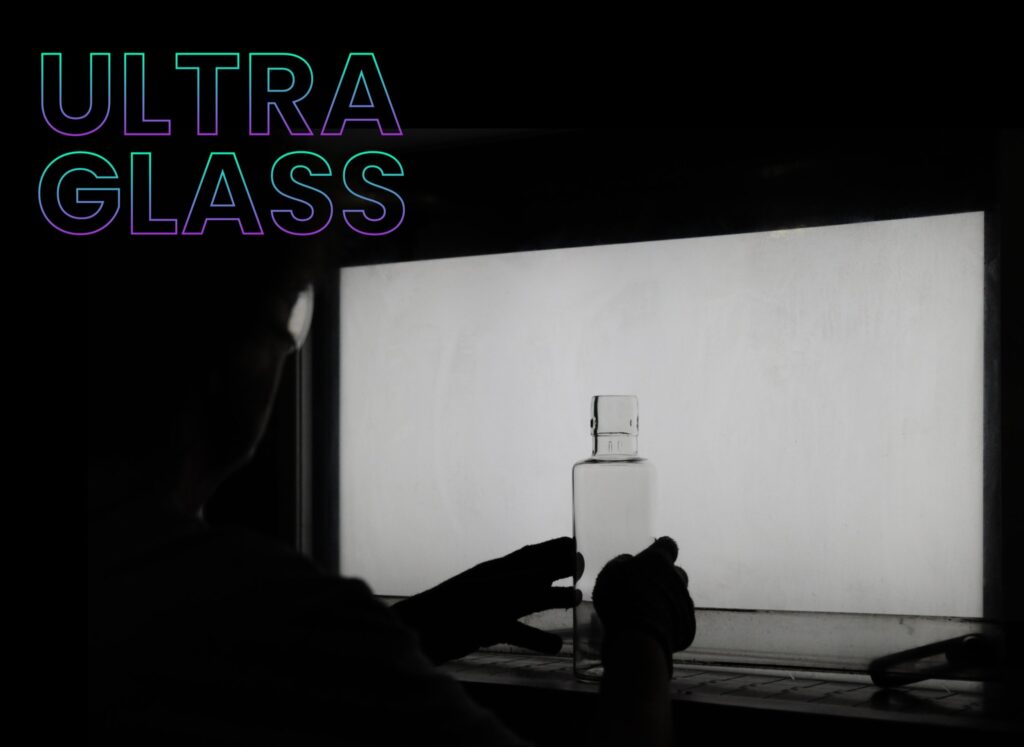
Yes, we’re already in the midst of our next big project to make soulbottles even more sustainable. With our ULTRAGLASS campaign, we’re currently raising funds to make our glass soulbottles significantly more shatter-resistant and lighter.

How did this project come about?

Paul, one of our founders, had been thinking for years about reviving the virtually unbreakable “Superfest” glass from East Germany. It’s not actually a new technology, but unfortunately, the brand didn’t survive the market logic of the West and capitalism at the time—because glass that doesn’t break doesn’t sell again.
For the past two years, we’ve been working with the Keylab Glass Technology team at the University of Bayreuth and Füller GmbH to develop more shatter-resistant and lighter soulbottles. Of course, it’s frustrating when, like me, you’re a bit clumsy and drop your bottle, only for it to break.
Aside from delighting our customers when their bottle survives a fall, the ULTRAGLASS campaign is also about shifting our mindset and getting excited about longer-lasting products. By reducing the weight, we save resources and emissions in glass production and transportation. However, the greatest ecological impact comes from the extended lifespan. That’s something we want to share with the world—and, more specifically, with the glass industry.

The ULTRAGLASS campaign by soulbottles runs until Sunday, April 30, 2023.

Anyone can support: whether as a company or an individual.

ultra glass